AnyView:
Synthesizing Any Novel View in Dynamic Scenes

1Toyota Research Institute
2Amazon Web Services
Summary
We introduce AnyView, a diffusion-based video generation framework for dynamic view synthesis. Given a single video from any camera trajectory, the task is to predict a temporally synchronized video of the same scene from any other camera trajectory. Unlike most existing methods that rely on explicit 3D reconstructions, costly test-time optimization, or are limited to narrow viewpoint changes, AnyView operates end-to-end and supports extreme camera displacements where there may be little overlap between input and output viewpoints.
Method
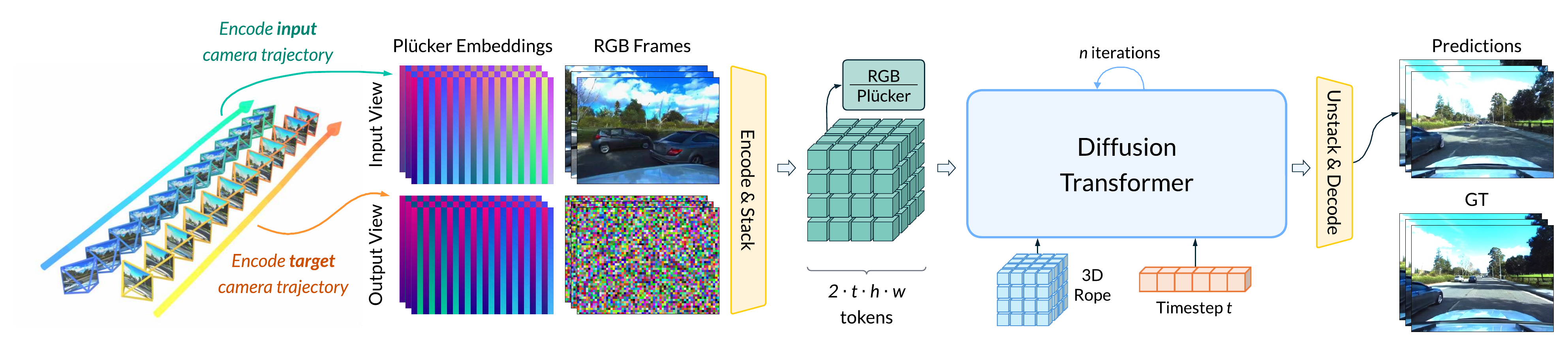
We adopt Cosmos, a latent diffusion transformer, as our base model. Rather than using warped depth maps as explicit conditioning, we rely solely on an implicitly learned 4D representation. We encode all camera parameters into a unified Plücker representation \( \boldsymbol{P} = (\boldsymbol{r}, \boldsymbol{m}) \), combining extrinsics and intrinsics into dense per-pixel ray and moment vectors. These embeddings are concatenated along the channel dimension, while both viewpoints are concatenated along the sequence dimension to form the overall set of tokens.
Representative Results
Extreme View Synthesis & Challenging Camera Trajectories
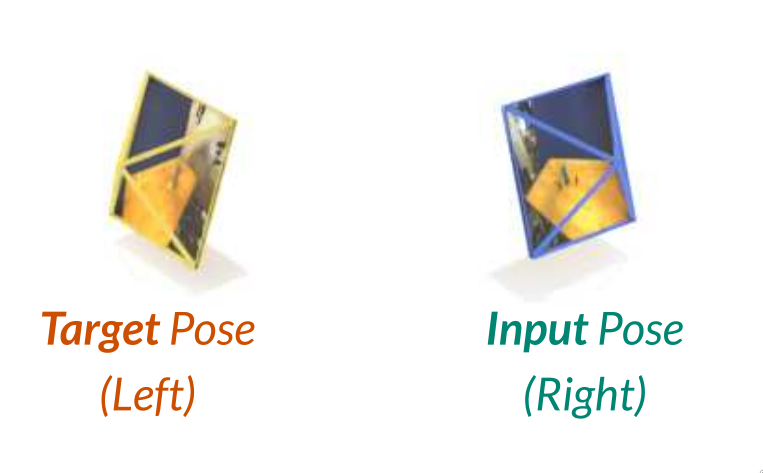
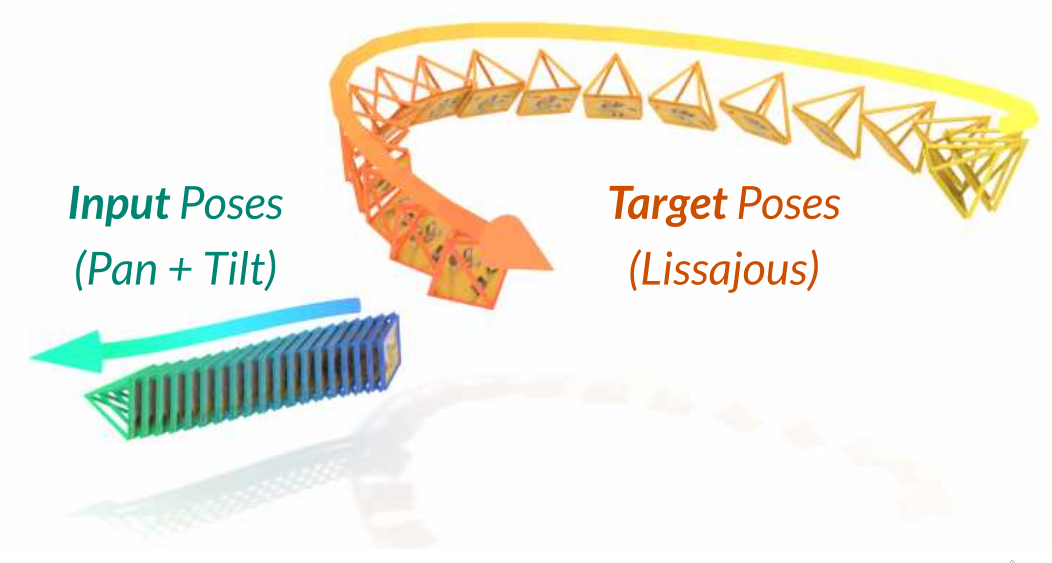
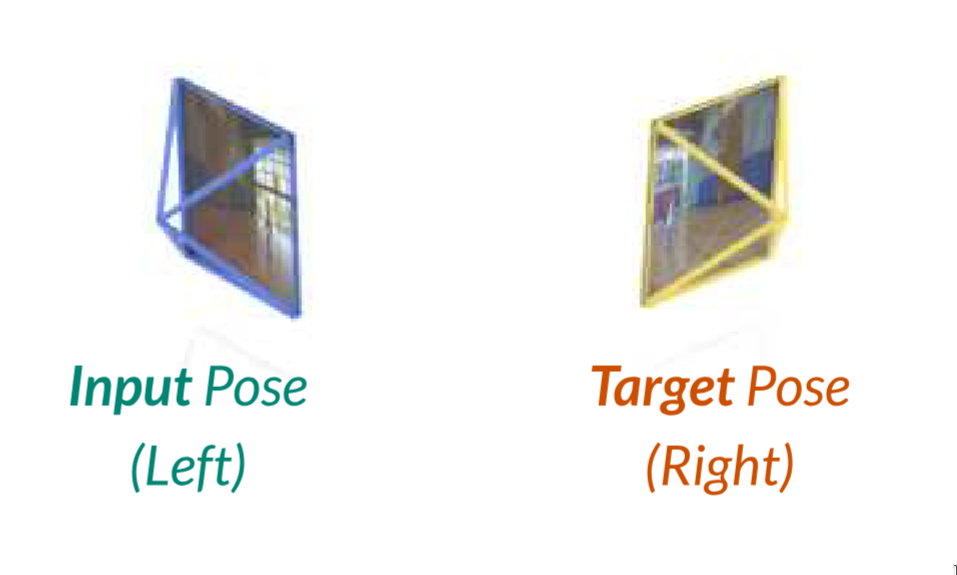
We run AnyView on DROID, Kubric, and Ego-Exo4D below, and visualize camera trajectories on the right, showing that AnyView is capable of performing consistent extreme monocular dynamic view synthesis with high fidelity, even when the camera poses become very complex (2nd row).
Datasets
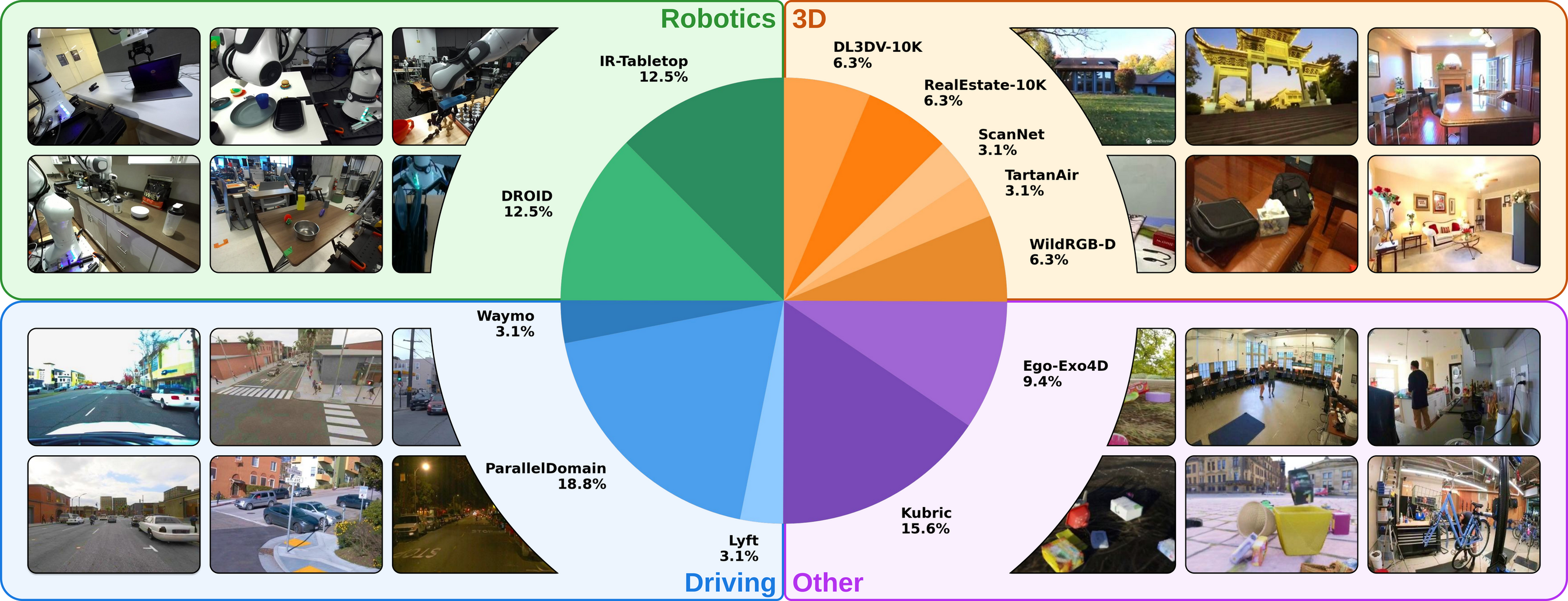
For training, we combined 12 different 4D (multi-view video) datasets across four distinct domains: Robotics, Driving, 3D, and Other. During training, we perform weighted sampling to ensure each domain is seen equally often (i.e. comprises 25% of the batch) to create a balanced representation.
Kubric-5D
We introduce Kubric-5D, a newly generated variation of Kubric-4D that vastly increases the diversity of camera trajectories, incorporating advanced filmmaking effects such as the dolly zoom. These scenes contain multi-object interactions with rich visual appearance and complicated dynamics, with synchronized videos from multiple viewpoints covering a diverse range of camera motions.
The dataset comprises 10,000 scenes, each rendered from 16 synchronized cameras placed at locations evenly distributed around the scene center, at 576 × 384 resolution, with 60 frames per video at 24 FPS. Unlike Kubric-4D, the cameras move: each camera's trajectory is sampled independently from 16 trajectory types (fixed, orbit, radial, elevate, straight and centered pans, nautilus spirals and sine waves with optional roll, dolly zoom, and Lissajous curves), focal lengths are fixed, shared-random, or per-camera random, and the number of objects and their spawn area are randomized as well. Every scene provides synchronized RGB videos and full per-frame camera intrinsics and extrinsics; depth is not part of the published archives and can be regenerated with the generation code. The dataset description, the split, the full archive list, the generation code, and the data license (CC BY 4.0) are at TRI-ML/Kubric-5D.
Direct download links can be found here:
- Kubric5D_tiny.tar.gz (100 scenes, 2.2 GB, RGB videos + camera parameters; sha256)
- Kubric5D_train_part00.tar.gz to Kubric5D_train_part09.tar.gz (9,600 scenes, 960 per archive in scene order, 20.5 to 20.8 GB each, 207 GB in total; all extract into one Kubric5D_train/ folder): part00, part01, part02, part03, part04, part05, part06, part07, part08, part09
- Kubric5D_val.tar.gz (200 scenes, 4.32 GB; sha256)
- Kubric5D_test.tar.gz (200 scenes, 4.25 GB; sha256)
- Kubric5D_index.json (every archive with its size, sha256 and scene range)
Every archive has a .sha256 file next to it. The download script in
AnyView-DVS
(python scripts/download.py --tier Kubric5D) fetches and verifies all of them.
AnyViewBench
We propose AnyViewBench, a multi-faceted benchmark that covers datasets across multiple domains:
- Driving: Argoverse, DDAD, Lyft-L5, ParallelDomain, Waymo
- Robotics: DROID, Kubric, LBM
- Human Activity: AssemblyHands, Ego-Exo4D
Direct download links can be found here:
- AnyViewBench_zeroshot.tar.gz (zero-shot: 5 datasets (Argoverse, AssemblyHands, DDAD, DROID, Ego-Exo4D), 320 episodes, 5.0 GB; sha256)
- AnyViewBench_indist.tar.gz (in-distribution: 8 datasets (DROID, Ego-Exo4D, Kubric-4D, Kubric-5D, LBM, Lyft-L5, ParallelDomain-4D, Waymo), 444 episodes, 2.0 GB; sha256)
Evaluation code and instructions: TRI-ML/AnyView-DVS.
Paper
Abstract
Modern generative video models excel at producing convincing, high-quality outputs, but struggle to maintain multi-view and spatiotemporal consistency in highly dynamic real-world environments. In this work, we introduce AnyView, a diffusion-based video generation framework for dynamic view synthesis with minimal inductive biases or geometric assumptions. We leverage multiple data sources with various levels of supervision, including monocular (2D), multi-view static (3D) and multi-view dynamic (4D) datasets, to train a generalist spatiotemporal implicit representation capable of producing zero-shot novel videos from arbitrary camera locations and trajectories. We evaluate AnyView on standard benchmarks, showing competitive results with the current state of the art, and propose AnyViewBench, a challenging new benchmark tailored towards extreme dynamic view synthesis in diverse real-world scenarios. In this more dramatic setting, we find that most baselines drastically degrade in performance, as they require significant overlap between viewpoints, while AnyView maintains the ability to produce realistic, plausible, and spatiotemporally consistent videos when prompted from any viewpoint.BibTeX Citation
                        @inproceedings{vanhoorick2026anyview,

                        title={AnyView: Synthesizing Any Novel View in Dynamic Scenes},

                        author={Van Hoorick, Basile and Chen, Dian and Iwase, Shun and Tokmakov, Pavel and Irshad, Muhammad Zubair and Vasiljevic, Igor and Gupta, Swati and Cheng, Fangzhou and Zakharov, Sergey and Guizilini, Vitor Campagnolo},

                        booktitle={European Conference on Computer Vision (ECCV)},

                        year={2026}}
All Figures
Below is a comprehensive gallery of videos corresponding to all figures in the paper, including comparisons with baseline methods and supplementary visualizations.
Acknowledgements
The webpage template was inspired by this project page.